Showing posts with label history. Show all posts

Friday, June 6, 2014

The USAF Flying Thunderbirds

IMG_2407 

The Flying Thunderbirds gave new meaning to the phrase shock and awe at the Cannon AFB air show we attended on May 24th (“Memorial Day 2014,” May 26, 2014). If you have never had the privilege of seeing them fly, add them to your bucket list.

IMG_2370

According to Wikipedia, and I know  one has to read Wikipedia with caution, the USAF Demonstration Squadron was first envisioned at Kelly Field, Texas, on June 13, 1917. According to the program from the show, the group began in 1947 when the US Army’s Signal Corps saw a need for a dominant independent air arm of the armed forces and the Thunderbirds were born in 1953 at Luke Air Force Base, Glendale, Arizona. The group is now based at Nellis AFB, Nevada.

IMG_2389

The Thunderbirds are named a USAF Air Demonstration Squadron, which means it does not have a numerical designation, and quite frankly, I am not sure what that implies in civilian language, but I do know that they are part of a USAF combat force that can be integrated into an operational fighter unit should the need arise. The aircraft currently used is an F-16C Fighting Falcon jet, which is usually just referred to as an F-16.

IMG_2391

The Thunderbirds are appropriately named after the legendary bird that is important in the mythology of many Native American cultures, especially the Pacific Northwest Coast tribes and some from the Southwest and Plains groups, such as the Lakotas, Ojibwas, Algonquins, and Kwakwakas. The bird represents the natural forces forces of thunder, lightning, and storms. and protects humans by fighting evil spirits.

IMG_2384

The thunderbird represents power and strength and its name comes from the belief that the beating of its enormous wings causes the thunder and stirs the wind. Experiencing the sound of the jets as they flew overhead, zoomed past the enthralled spectators, and in one maneuver, surprised us from behind, the jets  lived up to their namesake. And I will have to admit that it was not until I came home and looked at my pictures on the computer that I realized that, appropriately, the figure of a thunderbird appears on the bottom of each plane.

IMG_2410

Speakers had been placed all along the air strip so an announcer could alert the crowd as to what direction the jets would be approaching and name each maneuver as Top Gun-style rock music was played, which really added to the excitement of the flying. I missed taking pictures of some of formations, like flying head-on only to miss each other at the last minute and zooming in upside down because I was so fascinated just watching them do all those amazing things with those airplanes. I didn’t want to miss a thing while trying to look through a camera. Actually seeing it was more important than filming it, and besides, pictures don’t do them justice. You have to be there. They ended the show with a female voice, alas, I did not know the artist, singing a heartfelt rendition of “God Bless America,” which put a lump in my throat and tears in my eyes as the jets flew by one last time.

IMG_2435

IMG_2436 
Major Michael Carletti, hometown San Antonio, Texas, signed autographs for Korben Kron, friend Nickolas, and Ty Kron.

After they landed, the Thunderbird pilots were swarmed be kids and adults wanting to bask in the glow and receive autographs of these men and women who flew with such precision and skill. They made us all proud and humbled to be Americans.

IMG_2409

IMG_2417

Top gun, indeed.

Tuesday, September 4, 2012

History in a Junk/Antique Store

IMG_8879

Back in the day,my friend Nola and I spent many a happy afternoon shopping junk stores, looking for that waiting-to-be-discovered hidden treasure that we were sure we couldn’t live without. And in those days, the stores tended to be heavy on the junk; real antiques were few and far between in the stores we visited. But that didn’t mean the merchandise was any less appealing. It was just cheaper and matched our early-marriage budgets better. I’m sure big city bona-fide antique dealers cringe when they are lumped in the junk category, but face it, some old stuff is just junk. And it has been my experience that even if a dealer has true antiques, junk is also lurking around as well. And that’s not a bad thing.

IMG_8884

The beauty of having both kinds of merchandise is that there is something for everyone, and along the way, the customer winds up with a history lesson for the day, disguised as shopping.

IMG_8924

While in Kingsland the other day, I stopped at Southern Pickers, an antique store which also happened to have junk in the back.  I was told by Doug Chapman, dad of owner Mark Chapman, the store had been open about a year. As I looked around the front rooms of the building I was struck by how neat and orderly everything was arranged. Several beautiful hutches of the true antique variety displayed sets of older dishes; an old bed was dressed with an old handmade quilt, over which were scattered other linens, perhaps not as old, but still embellished with carefully hand-sewn embroidery patterns and tatting.  Along the shelves sat old-fashioned utensils and household items, all dusted and displayed for easy viewing. One small room was set aside for old military uniforms. I felt of the heavy wool material and marveled that soldiers could fight a war under the burden of those jackets. In some of the last rooms the furniture and items weren’t old enough to be true antiques but were certainly not modern.

IMG_8878

IMG_8914

IMG_8883

IMG_8881

IMG_8908These Mid-Week Pictorials, dated March 1918 are an example of the history that can be found in antique/junk stores.

IMG_8880

IMG_8906

As I opened the last door and walked into what was labeled the warehouse, I knew I had come to the junk part of the place. But wait… This was a large, open, high-ceilinged barn-type building, but where was all the junk? Where were the stacks and piles of old tools, magazines, dusty second-hand furniture, boxes of odds and ends, stuff  piled up and crammed into corners.? It was all right there, only it was just as neat and clean and orderly as the nice things up front. And it was a pleasure to take a trip back to the old days, way last century…

IMG_8890

And that’s where the history lesson comes in. As I looked at all the discarded and no longer desired artifacts of life, some were familiar to me, others not so much. Many of the old and rusty tools and farm implements I had seen before. This store had the typical cast-offs you expect to see in a junk store: lots of glassware, old tools, records, books, signs, salt and pepper shakers, glass utility pole wire insulators, rusty tools like an old post-hole digger, kitchen utensils that have been replaced by modern day conveniences, on and on.

IMG_8903

In the warehouse I had noticed a really nice wooden Indian and failed to take a picture of it as I was making my way through all the displays. When I went back to get the picture, it was gone! That quickly he had disappeared. Then I realized he was being wrapped and loaded into the bed of a pick-up that had pulled into the loading area. Luckily, another Indian was standing guard on the porch, so he was willing to pose for the picture.

IMG_8892

When this stove was new, it was shiny and clean, but can you imagine trying to cook Thanksgiving dinner on one of these? And by the time one meal was over, it was time to start working on the next one; everything was made from scratch.

IMG_8897

This wood lathe, above, and the farm press below are typical of the tools used generations ago. I fear today we don’t have a clue how to work with anything like them. We think we are so smart, but compare our tools to theirs, and compare the attention to detail and hands-on quality of what they were able to do without high-tech equipment.

IMG_8885

We take our lives so for granted and all the things that make our lives so easy. Visiting a junk store should make us all  appreciate the debt we owe to the generations before us that lived successful and happy lives without all the time and labor-saving devices we think we couldn’t live without. And I always wonder what will show up in junk stores of the future, what people will deem important enough to save to show to future generations. I also wonder how much of it will actually last long enough to make it into a museum disguised as a junk store. We are such a throw-away society that I am not sure anything will be around to display.

IMG_8888

So if you have never shopped  a junk store or an antique store, take the time to stop and visit the next one you see. You’ll be amazed at what what you may find and learn. And I suspect you will see something that brings back long lost memories and a smile. And if you are too young to have those memories, you might learn something about what you think is ancient history. Enjoy.

IMG_8902

My thanks to Doug Chapman, manager of Southern Pickers, who graciously visited with me and allowed me to take pictures of the store. If you wish to visit a neat, clean store with items categorized for easy viewing, visit the store located at 2247 W. Ranch Rd. 1431, Kingsland, Texas, near Lake LBJ.


Friday, August 31, 2012

The Blue Moon

Well, I completely missed the boat when I wrote about the full moon the other day(“The Moon is Amazing,” August 14 ) because when I told you to check out the next full moon on August 31st, 1 overlooked the the fact that this moon will be one of the fabled blue moons that we only get to enjoy about every two years.

5120829-MoonPhoto-hmed-0100p_files_grid-6x2

I wish I could take credit for this picture; alas, I can’t. Alamelu Sundaramoorthy of Portland, Oregon, took it on July 31st, so while it is not the anticipated blue moon,  it is an intriguing shot and probably looks similar to the moon as we will see it tonight. It is just so cool, I couldn’t resist sharing it with you.

So do you know why this moon is considered blue? I’ve used and heard the phrase “once in a blue moon,” and knew it referred to something that didn’t happen very often, something rare,  but I don’t know that I ever understood where the phrase came from. So I googled it. And here’s what I found out.

Two explanations are out there, the original one being that the blue moon is the fourth full moon in a season. The second definition surfaced in 1946 after a writer for Sky and Telescope magazine came up with two full moons occurring in the same month, which seems to be the more popular and accepted definition today.

Blue moons occur on the average every 2.7 years, but that doesn’t always hold true. Even rarer than a blue moon is a year with two months of blue moons. The last one happened in 1999; the next year with two blue moons will be 2018. All of this happens because our calendar months and the moon’s orbit don’t match up exactly. The moon’s cycle takes 29.5 days, and since our months are all longer than that, except for February, the way the timing works out, some months are blessed with more than one full moon from time to time.

So tonight, Friday, August 31st, while you are out enjoying that moon as you watch the football game-many of you will be watching a football game, right?-ooh and ahh over that glowing ball in the sky and bask in its light. And if you are not outside, grab a lawn chair and get yourself out there. You’ll have to wait till July 31, 2015, to experience it again.

Yes, the moon is still requesting your presence.

Pappas, Stephanie. “Catch Friday’s blue moon, or you’ll have to wait until 2015.”  www.msnbc.msn.com/id/48831835/ns/technology_and_science-science/?ocid=amsm…8/30/2012.


Wednesday, April 25, 2012

Aggie Muster

IMG_7367

One of Texas A&M University’s finest traditions is Aggie Muster, held each year on April 21st. This year we, along with J.D. Cage ‘61 and his t-sip (Texas) wife Julie, class of ‘65,  attended Muster in Plainview with the Plainview A&M Club. For those of you unfamiliar with Texas A&M, it might help you to know that A&M, founded in 1876, is a land grant, state-supported college that was all male and military until 1965. In fact, more A&M graduates served as officers in the U.S. military forces in WWII than any other school, including West Point and Annapolis. So the school has a strong military background.  The best way for me to explain Aggie Muster is to share with you the Muster Tradition, which is always read at the beginning of the evening. It goes like this:

Muster was first held in 1883, when Aggies met on June 26 to “…live over again our college days, the victories and defeats won and lost upon drill ground and classroom. Let every alumnus answer roll call,” wrote the former students, then known as ex-cadets.

During the late 1890s, April 21st was celebrated with an annual trip to the San Jacinto Battle Field. On occasion, the Aggies were called to help in recreating the historic battle of San Jacinto. A parade down Houston’s Main Street always followed.

In the early 1900s, it was agreed that in addition to honoring the freedom of Texas, April 21st would be a good time to pay homage to all students and former students who have passed on, and that some living comrade would answer “Here” when the roll call for the absent was read.

During the first World War, groups of Aggies observed April 21st in Europe and on army posts, but no formal campus observance was held. In 1923, the March Texas Aggie {magazine} urged “If there is an A&M man in one hundred miles of you, you are expected to get together, eat a little and live over the days you spent at the A&M College of Texas.“

By 1929, meetings had become international. In 1942, former Corps of Cadets Commandant, General George F. Moore ‘’08, served as the commander of Fort Mills on Corregidor Island in the Philippines. During World War II, Corregidor Island was used as a military fortress at the entrance of Manila Bay. Many Aggies served on the island under the command of General Moore  to resist a Japanese invasion of the Philippines. On April 21st, 1942, some twenty-five Aggies on Corregidor mustered to celebrate San Jacinto Day. On May 6, 1942, the island fell to the Japanese forces and all Aggies on the island were captured or killed.

Corregidor was retaken from the Japanese in 1945. After the war in 1946, Aggies that were present on “The Rock,” as Corregidor was called, held their own Muster at the mouth of the Malinta Tunnel.

And so it has been over the years, becoming one of Texas A&M’s greatest traditions. Muster is more than a ceremony. It is a way for Aggies to renew each year the loyalty and unity which constitute the foundation of their friendship for each other and love and devotion for our school.

IMG_7348The meal was followed by a video provided by A&M showing highlights of some of the programs at the main campus in College Station. 

After the video, I was invited to read the Muster Tradition, which I was glad to do. But I had not made it to the second paragraph before the knot stuck in my throat and my voice faltered with emotion. Reading the Muster always takes me back to attending Silver Taps on the A&M campus, which always made me cry.

Silver Taps is a ceremony honoring those Aggie students who have died for whatever reason during the school year. The name of the deceased is posted on the flag pole by the statue of Lawrence Sullivan Ross in front of the Academic Building, and students know that Silver Taps will be held that night.  That night at the designated time, students and all who wish to attend gather at the Academic Building in silence in the dark,  Taps is played, followed by a 21-gun salute. And then just as quietly as they have  come, everyone silently slips away in the darkness. 

At Muster, we have a form of Silver Taps. A list of all Aggies, students and former students, who have died in the past year is supplied by the university, and everyone checks the list to see if anyone is on the list for whom they wish to answer roll call.  Then those names are called, someone answers “Here” and lights a candle in their honor. This, too, is a very emotional time.

IMG_7349David Hooper ‘85 checks the list of fallen Aggies.

IMG_7354Bill Liles ‘68, answers roll and lights a candle for an old friend.

After Silver Taps, we sing the school song, “Spirit of Aggieland” and have a short business meeting, which usually concerns club scholarship winners.

IMG_7359Kenneth Hooper ‘81, conducted the business meeting and introduced the Plainview club’s scholarship winners:

IMG_7363Lauren Johnson, senior at Plainview Christian School, and Kaitlin Hukill, senior from Plainview High School, who  will be attending A&M this fall.

And then  Muster closes with this Muster Prayer:

Our Father, as Aggies come together in all parts of the world, we pause to praise thee for the many material and spiritual blessings of this past year.

We are humbly grateful for our Aggie heritage and the comradeship we enjoy.

Strengthen this sense of our God-given love and friendship. May it spread to men and women of all schools, nations, and races and bring people of the world into a new bond of friendship and peace.

Fill with thy presence the circle of our friendship that is broken by an absence in our roll call. May we have a reverent appreciation for the great examples and sacrifices given by those of us we honor with Silver Taps. Bless the inspiration of this occasion that we may be strong in body, keen in mind, friendly in society and religious at heart.

Through thy grace, we pray, Amen.         

IMG_7360

IMG_7364Fred Robertson, class of ’50 with David and Priscilla Hooper, who organized the Muster.         

Non-Aggies are always welcome at Muster. Next April 21st find an Aggie and tag along. You’ll go away with a good feeling.

Softly call the Muster,

Let comrade answer, “Here!”

Their spirits hover ‘round us

As if to bring us cheer!

   - from “Roll Call for the Absent,” by Dr. John Ashton ‘06 (1906)

Tuesday, February 28, 2012

In Honor of Black History Month

February is Black History Month, and before we turn the page on the calendar,  I want to say thank you to some of the Americans of African descent who have enriched my life.

Thank you to George Washington Carver for his work with peanuts.  While he didn’t invent peanut butter, which was my impression-the Aztecs actually did-he is sometimes given credit. He promoted the crop, supplied recipes using peanuts, and developed around 100 products made from peanuts, not to mention his  many other contributions as a scientist, botanist, educator, role model, and inventor. I used to sit down with a spoon and eat peanut butter straight out of the jar. I ate my way through high school on peanut butter, Miracle Whip, mustard,  and lettuce sandwiches. Okay, now I can hear the collective yuck! out there, but before you knock it, try one: peanut butter on both pieces of unhealthy white bread, mustard on one side, Miracle Whip on the other- and here’s the secret- a thick batch of iceberg lettuce in between. Williams Sonoma recipe inventor, eat your heart out.

I may get hammered for my next choice, and I grieve for the heavy hearts and weary bodies that sought respite and strength in them and  gave them life, but I value the Negro Spirituals, or Afro-American Spirituals, as they are now  labeled in my church  hymnal.  Spirituals are filled with  lovely harmony and melody,  succinct lyrics, are sincere in their faith, and provide hope and comfort when listened to or sung. These songs obviously mean something entirely different to me than to their original composers and the black experience today,  but the songs nevertheless provide me with beautiful music to comfort my soul and express my faith.

Seems to me the spirituals must surely have given rise to modern day blues, another musical genre that the black community has given us, and one that I enjoy immensely. Thank you especially  to B.B. King, the wonderful Etta James, and Bobby “Blue” Bland for their brand of blues. Blues speak to the unhappy human condition, but by the time the song ends and the soulful  harmonies enjoyed,  the listener is beginning to smile, shakes it off, and is a bit more ready to  face the adversities that may have to be dealt with next.

And then there is the incomparable Ray Charles. From his early R&B albums to his country music arrangements, I have them all. During my high school days I would put a stack of his LPs on the stereo and not drift off to sleep until they had all played. I loved it.

As to other black voices that I love to hear, thanks goes to Tina Turner, The Platters, Chuck Berry, Little Richard, Bo Diddley, Jimmy Reed, Johnny Mathis Earth, Wind, and Fire, Pointer Sisters, Quincy Jones (am I showing my age or what?)  that grace my stereo on many occasions. 

And I have to  pay homage to Whitney Houston in what had to be her finest hour, performing our National Anthem at the Super Bowl. She didn’t miss a note, didn’t forget the words, and didn’t do anything stupid at the end.  The sheer joy and exuberance with which she sang, smiled, and waved to the crowd couldn’t help but make me smile and always brings tears to my eyes every time I hear and see her performance. 

Thank you to Ethel Mae, who was the housekeeper for my friend Carol Sue’s family growing up and who always looked after us when necessary, and to the other black women who kept the households running smoothly and the children on their best behavior. Just like the women recognized in the movie The Help, they were brave, strong, and contributed to many a family’s success then, and many still do even now, I suspect.

Thank you to George who was employed by my dad for more than 25 years. I don’t know that I ever knew his last name- kids don’t worry about stuff like that- but I do remember that there were weekends every now and then that George would sort of overdo things. Daddy would get a call on a Monday morning and then go retrieve him out of jail, after which it would just be work as usual. George was a valued employee and friend.

I have no philosophical, profound conclusion to all this rambling. I just wanted to say thank you to the black Americans who have touched my life in some way. Your gifts have been many, and I am glad you shared them with America. And me.

Tuesday, February 7, 2012

Muleshoe Heritage Center-There’s More

Let’s look at the rest of the historical structures that have been added to the Heritage Center and meet some of the people who are important to its existence.

IMG_6539

The one-room school house came from the Stegall community, southwest of Muleshoe. The little school is outfitted with the old-fashioned wooden desks that connect to each other, a pot-bellied stove, benches for other community occasions, a blackboard with cursive writing examples on top, a water bucket for the kids, lunch pails made from syrup cans, lots of  things typical of the era. One well-known former student was Francis Gaddy Stegall, whose  family moved to the Stegall community in 1922, and she attended the school when it opened in 1925. Later she went on to marry Frank Stegall and became an author and artist.

IMG_6456

The 50s House is not an historical structure of the oldest variety, although it was originally the office of Walt Sain. What’s historical about the 50s house is what it contains:  a nostalgic blast from the somewhat recent past, 50s memorabilia and furniture: an early TV; records and a record player; movie posters; dinette table and chairs, all kinds of things. Other rooms of the building house an old post office, a dentist’s office complete with dentist chair and implements, all from local dentists Andy Lewis, Charles Lewis, and A.Z. Beaty. A  medical doctor’s room is furnished with artifacts from Drs. Slemmons, McDaniels, and Birdsong.

IMG_6460

IMG_6451IMG_6452

The storage barn used to be just that-for storage. Now it is also the home of  the Branding Wall, which started out as a money-making project but serves to provide history lessons about the area. Families provided the history of their family brand, which was written out in metal-art, and then the Foundation held branding parties, three in all. The families brought their branding iron, which was heated in the flames of a typical old West range fire, and the brand was then burned on a piece of wood to go above its history. A total of 58 brands and family histories are displayed on three sides of the barn and the wooden fence behind it. 

IMG_6459

The Heritage Foundation purchased one of the school district’s temporary buildings when the recent school renovations were completed. The plan is to turn it into  a visitor’s center, with public restrooms, the business office, visitor information, a gift shop, and a display area for local collections to be shared.

IMG_6457

Still undergoing reconstructive surgery, the newest addition to the center is the Yellow Jacket Inn. Believe it or not, the Muleshoe school mascot used to be a yellow (probably gold) and purple yellow jacket. I think the Mules were adopted in 1950, but since the Yellow Jacket opened in 1946, I have to figure that is how the name came about.  And it was painted yellow. The Yellow Jacket was located on West Avenue D behind De Shazo Elementary, within walking distance of the junior high and high school students as well. The eatery changed hands a few times, from original builders/operators Clay and Jennie Beavers to Spenser and Phyllis Border Beavers to Charles and Hazel Ball who owned it when it closed in 1999. Ace and Esmeralda Hanaway bought the Yellow Jacket property and donated the building in memory of Charles and Hazel Ball to the Heritage Foundation in 2009. Kenneth Henry was instrumental in its move to the Heritage Center.  The most popular item on the menu was said to be the golden corn dog.

IMG_6531IMG_6547

Ray West, Muleshoe class of 1954, and his wife Donna, now live in Midland, but Ray still has fond memories and ties to Muleshoe, and has been a dedicated supporter of several entities in town. The Heritage Foundation has benefitted greatly from his generous financial endowments which enabled the Foundation to purchase land for expansion of the center, land purchased in honor of Ray’s mother and dad, Theron and Leatha West. Recently land was also purchased for an RV park. The park is a community effort, with the Foundation getting help from the city and county with construction and maintenance. Visitors can camp for the first three days at no charge with a fee assessed after that. The hope is that the easy-in, easy-out design and the many area attractions will encourage people to stop and stay a while. For those of you planning a summer trip, it should be up and running by vacation season.

This story is running long, so I won’t go into the other things in the Center to see that I haven’t mentioned, like the working windmill, the museum in the basement of the Janes House, the granary,  and other  odds and ends that the modern world no longer uses but helped get us  where we are today.

IMG_6464Dolores Harvey, Center manager and hostess, is on hand every afternoon and by appointment to give tours of the center and schedule events for you.

IMG_6875Long time Foundation member Sammie Simpson is part amateur historian and sleuth who has devoted much time and energy researching and then outfitting the historical structures with period-appropriate artifacts down to the smallest details. 

IMG_6503 Membership in the Foundation stands at 103 and dues are  $25 a year. The board meets once a month in the Depot meeting room and regular members and visitors are welcome to attend.  Current board members are, left to right: Rodger Buhrman; Sheila Stevenson, secretary; Dolores Harvey, manager; Gene Rogers; Bobbie Harrison, vice-president; Kathy Vandevender; Tom Watson, president; Gina Wilkerson; Lacy Vardeman; Lonnie Adrian, Tour de Muleshoe chairman; Norris Conkin, treasurer; and Paul Poynor. Not pictured are Charles Hamilton, Marcha Rasco, and Chris Mardis, SCAC sponsor.

The Heritage Foundation does not run itself, and many people, such as those currently serving on the board as well as many others,  have given of time and talent to make it a meaningful living museum. Jean Allison and the kids responsible for the Save the Depot movement can be credited with its birth; people like Vivian White, R.A. Bradley, Dan Throckmorton, Charles Thomason, Kenneth Henry, Dolores Harvey, Ruth Hall, Ronald McCormick, Jennie McVicker, Maureen Hooten, Jerry Sowder, Cara Juan Schuster, Sheila and Joe Bob Stevenson,  and so many other along the way are to be commended and appreciated for their hard work and dedication. If I left someone off who needs to be recognized, please feel free to correct my oversight in a comment to the blog.

I would also like to encourage you to take a tour one of these days. Just like people who live in New York have never been up the Empire State Building, I’ll bet most of Muleshoe has never toured the Heritage Center. It is well worth your time, and when you have out-of-town visitors, take them, too. You will all be surprised at what history has to offer.


Thanks to Dolores Harvey, Sheila Stevenson, Helen Cook, Jean Allison, and Maureen Hooten for their help gathering information for this article.

Tuesday, January 31, 2012

Muleshoe Heritage Center

IMG_6528

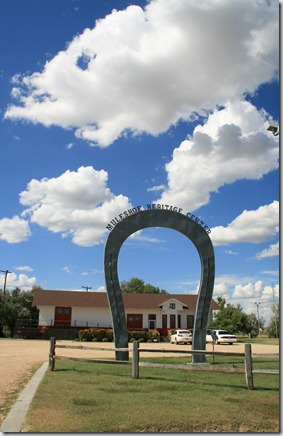
At the west end of town, on the north side of U.S. Highway 84, also known as  American Boulevard, you will pass a very tall, imposing mule shoe, the world’s largest, in fact. This jenny slipper marks the entrance to a labor of  love, the Muleshoe Heritage Center,  that has been a work in progress since 1982 when the Santa Fe Railroad closed their Muleshoe depot and talked of removing it from that location, one way or another.

IMG_6536

Santa Fe officials offered to donate the building to the city of Muleshoe if the city was willing to shoulder the cost of moving it to another location; the city was not, and  word spread around town that the historic old landmark  was to be demolished. Todd Holt, a Muleshoe High School senior at the time, was not willing to let that happen. So Todd, Laura Leal, Ronda Dunham, Joni Sudduth, Abby Kennedy, Belinda Clayton, Annette Crabtree, Mike Foss, Jay Pearson, Lori Stroud, and others who wanted to help, asked Jean Allison, their government teacher, if they could meet in her room to organize a plan of action, and the Save the Depot movement was born.

And born with vigor. The kids held a couple of car washes and some other fund raisers, which no doubt also created some consciousness-raising within the community that historic buildings like the depot should not perish but stand to educate future generations about early life in Bailey County. The depot was eventually saved and moved, thanks to the kids’ hard work, which led to the formation of SCAC, the Student Community Action Club, sponsored by Mrs. Allison at the high school, and the creation of the Muleshoe Heritage Foundation. Both organizations still exist today and work together to move, preserve, and restore other buildings that tell the story of Muleshoe and Bailey County.

IMG_6545

The Depot was moved in 1985 and dedicated in 1987. The ticket and passenger waiting room,  decorated with period furniture and historic memorabilia, and the freight room, outfitted with meeting area and full kitchen, can be rented for meetings, parties, and the like.

Once the Depot had been moved and preserved, other historical structures followed. I will give you an overview of the things you will enjoy touring when you visit the center, which is open for tours.

IMG_2607

What I consider to be the centerpiece of the Heritage Center is the Janes Ranch House, but then I am a bit biased since we were privileged to live in the house for a year after moving to Muleshoe in 1980. Originally located on the Janes Ranch about seven miles east of town, the wood and stucco structure was a mail-order house purchased by cattleman John Janes for his new wife, ordered from the Aladdin Mail Order House Company, shipped to that aforementioned Santa Fe Depot, and completed in 1915. West Texas is not known for its forests, you know, and lumber would have to be transported in anyway, so it was not uncommon to see mail order houses delivered in remote areas, such as West Texas, complete with the lumber and  everything else needed, including the instructions of how to put it all together. This model was no doubt one of the high-end kits, complete with two stories, a basement, a fireplace on every floor, a laundry chute that ended in the laundry room in the basement,  a ballroom, a coal bin, a walk-in safe, a small wall safe upstairs (which is no longer there), an outside door for ice delivery into the wooden ice box, carbide/electric lighting, and indoor plumbing. I don’t know if the plumbing was added later or was original, but since there was a bathroom on every floor, I choose to think it was original.

IMG_2609

The Figure 4 Ranch House came from South Bailey County and served as headquarters for the Figure 4 Ranch, owned by H.M. McCelvey of Temple, Texas, who bought the 42 section ranch in 1906 as an investment and then hired Henry Hanover, also from Temple,  to run the place.  The house was built sometime before 1916, and Hanover’s wife and three girls made a life for themselves there until  Hanover retired and moved to Muleshoe. One of his daughters, Katherine Sanders, was a teacher for many years is the Muleshoe school district.  Later Mr. McCelvey divided and sold sections of the ranch which were turned into farms, and years after, the ranch house became a part of the Heritage Center.

IMG_6461

The Virginia City Hotel was built to provide lodging for prospective land buyers, farmers,  who were lured to the area by the break-up of the XIT Ranch and three wet, rainy years. A land baron named Matthew C. Vaughn from Waterloo, Iowa, filed the first town plat in Bailey County on the Fort Sumner Road, named it Virginia City, and hoped it would become the first County Seat. Looking nothing like what we expect of a hotel, the second story was one large room big enough for eight cots. The first floor had two rooms, a kitchen and an office that was also the Post Office. Unfortunately, the good rains stopped, and after three years of extreme drought, Virginia City became a ghost town. Maple Wilson bought the hotel and moved it two miles west of Maple for his ranch headquarters, and later it housed his tenants before it became a part of the Heritage Center.
IMG_2614

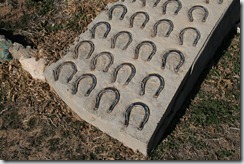
The World’s Largest Muleshoe was first installed here by the Depot parking lot  in 1994, an Eagle Scout project conceived and completed by Kermit Price, with a little family help. Made of I-beam steel and big enough to drive a semi tractor-trailer through, the monument was moved in 2008 to its present location beside the highway as a more prominent marker to the entrance of the center. Kermit financed his project by selling sets of mule shoes to be embedded in two intertwined concrete mule shoes that were placed in the ground near the monument. Those shoes are engraved with the donors’ names, which gives them a place in the history of the center.

IMG_2613IMG_6543

IMG_2608

From 1903 to 1907 Edward K. Warren and his son Charles, Michigan manufacturers  of buggy whips and corset stays, bought 80,000 acres of land in this area for what would become their ranch, named the Muleshoe Ranch. Stories differ as to why the owners named it the Muleshoe Ranch, but I am told that the town of Muleshoe was named after the ranch since the town grew up on the ranch’s land as the railroad came through.This Muleshoe Ranch’s Cookhouse/Bunkhouse fed and sheltered many a cowboy In its day and was a fitting addition when it was moved to the Heritage Center in 1986.

IMG_6455

A recent addition to the Center is the dugout home donated by the Bundrant family. The dugout came from Goodland in southern Bailey County and was reportedly lived in during the 30s by the Gentry family and later some of  the Bundrants during the 40s. After a real house was built and the Bundrant family moved, the dugout was sometimes used by the kids as a playhouse.

IMG_6462

The Log Cabin is the only structure in the center that is not typical of this area. How could it be without native trees to become the logs? But even so, many early settlers and pioneers lived in log cabins, so its historical significance earned it a place in the Center.  The cabin was found in the North Canadian River bottom near Shawnee, Oklahoma, and donated and moved to Muleshoe by John Fried. Much work and repair had to be done to the cabin to restore its original form, a one-room structure with a sleeping loft for the children.

As I mentioned earlier, the Heritage Center is a work in progress. Next week’s blog will spotlight more buildings that have been added and a few that are currently being restored and readied for viewing.


Thanks to Shelia Stevenson, Dolores Harvey, Jean Allison, Toll Holt, Laura Leal, Kelly Robinson, and Arnold Price for helping me gather information for this article.

Much of the historical background of the buildings that I included came from the brochure “Experience Our Heritage,” written by Jean Allison and available at the Santa Fe Depot in the Heritage Center.